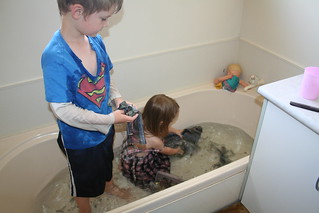
Rocket Boy LOVES watching MythBusters, always hanging out for a new episode, but will happily watch old ones over and over.
A few weeks back we watched one of the Alaska specials where they tested a myth about a unsinkable aircraft carrier made out of Pykrete.
Pykrete
From Wikipedia, the free encyclopedia
A slab of pykrete
Pykrete is made of 14 percent sawdust and 86 percent water by weight.
Pykrete is a composite material made of approximately 14 percent sawdust or some other form of wood pulp (such as paper) and 86 percent ice by weight (6 to 1 by weight). Its use was proposed during World War II by Geoffrey Pyke to the British Royal Navy as a candidate material for making a huge, unsinkable aircraft carrier. Pykrete has some interesting properties, notably its relatively slow melting rate (because of low thermal conductivity), and its vastly improved strength and toughness over ice; it is closer in form to concrete.
Pykrete is slightly more difficult to form than concrete, as it expands during the freezing process. However, it can be repaired and maintained using seawater. The mixture can be moulded into any shape and frozen, and it will be extremely tough and durable, as long as it is kept at or below freezing.
In 2009, the Discovery Channel program MythBusters episode 115 tested the properties of pykrete and the myths behind it. First, the program's hosts, Adam Savage and Jamie Hyneman compared the mechanical properties of common ice, pykrete and a new material specially created for the show, dubbed "super pykrete", using newspapers instead of woodpulp. Both versions of pykrete indeed proved to be much stronger than the chunk of ice, withstanding hundreds of pounds of weight. The super pykrete was much stronger than the original version.
The MythBusters then built a full-size boat out of the super pykrete, naming it Yesterday's News, and subjected it to real-world conditions. Though the boat managed to float and stay intact at speeds of up to 23 miles per hour (37 km/h), it quickly began to spring leaks as the boat slowly melted. After twenty minutes the boat was deteriorating, and the experiment was ended. The boat lasted another ten minutes while being piloted back to shore.
|
Normally on MythBusters they remind you 'do not try this at home' but when Rocket Boy asked to make a small scale Super Prykrete boat I couldn't see why not.
As Daddy was home I was more than happy to hand the job off to him to complete with Rocket Boy. The following photos and explanations are by shared by Rocket Boy.
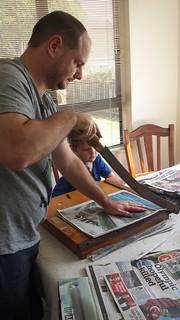
Daddy is cutting up newspaper.

I am putting newspaper in water.

We are moulding the wet newspaper into a boat.

In the freezer for the night.

Frozen solid.

Put in the water.

Added Lego figure.

15 minutes later.

The boat lasted 22 minutes.